A Customer Used This Peppermint Spray for a Month: Clear at First, Then Quieter
Brain & Focus Spray is a sugar-free peppermint spray from Shroomwell, a mushroom company outside Tallinn, shipped within Europe only. One four-star review describes a month with it, so I put her month beside the twelve-week trial.

This is a paid advertisement. Sponsored by Shroomwell.

Martin Keel is the pen name of this desk. The customers quoted on this page are real; their reviews are public on the seller's site, were written in Estonian, and are quoted here in translation.
I haven't met them and know nothing about them beyond what they wrote. The small photos beside their reviews are illustrations, not the reviewers.
Everything about the bottle, from the label to the shipping table, comes from the seller's own pages, read on September 3 and checked again on September 6, 2026.
Most people who try something for a month don't write it down.
Marta did.
She bought this spray, used it for about a month, and left a four-star review on the seller's site, in Estonian, that reads like a lab notebook.
At first it worked: clarity of thought and energy. She learned to take it in the morning, because later in the day it kept her up.
And by the end of the month the effect no longer felt as strong.
That's the most useful thing anyone has written about this bottle, and the seller published it themselves.
I'm going to use it as a map.
Week one, the timing, week four.
And at each stop, what the trials say about whether her month makes sense.
Here's what the bottle is.
Thirty milliliters of clear liquid in a white plastic bottle with a pump that doesn't let air back in.
You shake it and spray five times into your mouth, once a day.
Sugar-free, sweetened with xylitol and stevia, flavored with peppermint oil, vegan.
Inside: an extract of lion's mane mushroom, an amino acid from tea, an extract of a root from India, and three B vitamins.
Made by a company that grows mushrooms in Estonia, and sold from its own website to addresses in Europe.
Not to the United States. I'll say that again where it matters.
That's the whole product. No capsules, nothing to swallow with water.
Six things inside that the label bothers to count.
I did what I always do.
I read the label before the listing.
I read the trials behind each of the six things, at the doses they actually used.
I read all seventeen reviews, in translation, and kept the three that tell you something.
And I read the shipping table, which decides whether you can buy this at all.
What I found is a bottle that can plausibly give you Marta's first week, and no reason at all to expect it to give you the twelve-week trial.
A Name on the Tip of Your Tongue, and a Page You Read Twice
Let's start with you, not with the bottle.
If you opened a page about a focus spray, something small has probably been nagging at you.
Maybe it's names.
You've known the man at the hardware store for years, and for three long seconds his name just isn't there.
Maybe it's reading.
You get to the bottom of a page and realize you couldn't tell anyone what it said.

Or maybe it's the kitchen.
You walk in with a purpose, and by the time you reach the counter, the purpose has gone back to the other room.
Sound familiar?
It happens to people at every age, and it happens more when you're tired, rushed or doing two things at once.

You don't need a scare to care about it.
You'd just like your mornings a bit sharper, and your afternoons not to fall off a cliff at three.
So what are we really talking about here?
Attention, mostly. The name usually comes back an hour later, which tells you it was never gone, just slow to turn up.
And what did Marta say she felt?
Clarity of thought and energy, in her own words. Not a better memory.
I'm going to hold this bottle to her words, not to bigger ones.
Sharper mornings. That's the size of the goal on this page.
Why Another Cup of Coffee Doesn't Quite Do It
Most of us already have a plan for a slow morning.
It's called the second cup.
And it works, for a while.
Then three o'clock comes, you reach for the third, and that one follows you to bed.

Then there's the phone.
You sit down to read and check it twice before the first paragraph is over. No wonder the paragraph doesn't stick.
And there's the habit of trying harder instead of trying earlier.
We stare at the page longer, when what we needed was to do the hard reading at nine instead of at four.
Isn't that why people buy something like this?
Yes, and it's a fair reason. A small thing you do on purpose every morning can be the hook the rest of the day hangs on.
Then what's the catch?
Expecting the bottle to do the whole job. The label and the studies describe something smaller, and I'd rather you bought the smaller thing with your eyes open.
So let's hold this bottle up to Marta's month, one week at a time.
"Clarity of Thought and Energy," and What in the Bottle Can Act in an Hour
Marta's first week is the easy part to explain.
The honest part is that the mushroom probably isn't the explanation.

Three things in five sprays can plausibly be felt within the hour.
The peppermint.
A strong mint on a dry tongue at nine in the morning wakes anyone up for a few minutes. That's not pharmacology; it's a mint.

The sweetness.
Xylitol and stevia give the spray a sweet, cool taste with no sugar. Sweet and cold on the tongue is a small jolt, and it's gone in ten minutes.
And the L-theanine, which is the one with a study in your age group.
In a placebo-controlled study of Japanese adults aged 50 to 69 with normal mental-status scores, a single dose of L-theanine went with faster reaction times on an attention task and more correct answers on a working-memory task. [1]
The published summary doesn't give the dose in milligrams or the number of people, so I can't tell you whether 50 milligrams is what they used.
I can tell you the effect was measured hours after one dose, not after a month.
Mint, sweetness and one amino acid with a single-dose study. That's a first week, not a month.
The B vitamins don't belong in this list, and I want to say why plainly.
Half a day's B1 and B3, for a man who eats breakfast, changes nothing he can feel.
A hundred days' worth of B12 doesn't either, unless he's actually short of it.
A 2018 Cochrane review of 14 trials in nearly 28,000 people who weren't short found that B-vitamin supplements probably have little or no effect on thinking, at any point up to five years. [2]
If you wonder whether you're short of B12, and after 60 the stomach takes up less of it, that's a blood test and a conversation with your clinician, not a spray.
Why She Learned to Take It in the Morning
The second thing Marta wrote is the one I'd underline if I owned the bottle.
Taken later in the day, it kept her up well past her usual hour.
I can't tell you which ingredient did that.
There's no caffeine on the label, and the mushroom, the root extract and the amino acid are usually described the opposite way.
What I can tell you is that a mint, a sweet taste and a small ritual at four in the afternoon are the wrong way round for a man who wants a quiet evening.
Her answer was the right one: morning.

So here's the rule I'd write on the box.
Next to the coffee, at breakfast, and nowhere else.
A bottle that lives on the afternoon shelf will cost you an evening. A bottle that lives next to the coffee tin costs you four seconds.
"The Effect No Longer Felt as Strong," and the Twelve-Week Trial Behind the Mushroom
Now the hard part, and the reason this page exists.

Lion's mane is a white, shaggy mushroom that grows on hardwood trunks in the autumn.
It has one trial worth reading in people your age.
Thirty-one healthy adults over 50 took a preparation of dried lion's mane fruiting body, 3.2 grams a day, or a placebo, for twelve weeks.
At the end, the mushroom group scored higher on a standard mental-status test than the placebo group, and on a test of visual memory, nothing changed. [3]
Read the three numbers in that trial against the bottle.
Twelve weeks, where Marta used it for four.
Three thousand two hundred milligrams a day of the whole dried mushroom, where the spray gives 250 milligrams of an extract.
And a scored paper test, not the feeling of a clear morning.
3,200 milligrams for twelve weeks in the trial. 250 milligrams a day in five sprays.
The trial is twelve weeks at almost thirteen times the weight, of a different preparation, measured a different way. Her month and the trial aren't the same experiment.
Is there any study where lion's mane did something quickly?
One small pilot, in 41 adults aged 18 to 45. A single 1.8-gram dose went with faster scores on a color-and-word test an hour later, and after 28 days the other measures showed only a trend. [4]
Young adults, seven times the spray's daily amount, and a trend after a month.
The researchers asked for caution, and so do I.
So I'll say the two honest sentences.
Marta's fading isn't evidence that lion's mane doesn't work, and her clear first week isn't evidence that it does.
What fades in a month is usually the novelty. What's left after the novelty is the mushroom, and at 250 milligrams a day, the trials haven't looked.
The Mushroom Itself, From a Beech Log to a Dinner Plate
Before we leave lion's mane, it's worth knowing what it actually is, because it's friendlier than the word "extract" makes it sound.
It's an edible mushroom that grows on older beech and oak trees in forests across the northern half of the world.
Do people really eat it?
They do, especially in East Asia and the United States. Cooks compare the texture to crab or lobster, and in Japan it has a lovely old name: yamabushitake.
So is the spray just mushroom in water?
Not quite. The spray carries an extract, 250 milligrams in the daily five sprays, while the trial used 3.2 grams of dried whole mushroom a day. [3]
That's a different preparation as well as a different amount.
An extract and a dried fruiting body aren't the same thing, and nobody has measured one against the other in people your age.
Could I just cook it instead?
You can, if you find it at a market and you like mushrooms. Nobody has tested a plate of it on anything either, so you'd be doing it because it tastes good, which is a fine reason.
One caution, and it's a simple one.
If mushrooms don't agree with you, this bottle won't either, because the mushroom is the second ingredient on the list.
A forest mushroom, a kitchen ingredient, and a small extract in a bottle. Three different things with one name.
Ashwagandha: 25 Milligrams, and the Trial Used 300 for Ninety Days
Third on the label, and the one with the biggest gap between the trial and the spray.

Ashwagandha is a small shrub of dry ground in India, with orange berries in papery husks, and its root has a long place in Ayurvedic practice.
The bottle prints the sentence that it contributes to normal mental and cognitive activity, which is a traditional-use sentence, not a trial result.
The trial that exists is in younger people.
One hundred twenty-five adults aged 20 to 55 who said they felt under pressure took 300 milligrams a day of a slow-release root extract, or a placebo, for ninety days.
The ashwagandha group scored better on memory and attention tests at the end. [5]
Three hundred milligrams a day for ninety days, in people under 55. Five sprays give 25 milligrams: twelve times less, in a different age group, for a third of the time.
One practical note matters more than the arithmetic.
Rare reports of harm to the organ that processes what you swallow have been described with ashwagandha products.
If you notice unusual tiredness, dark urine, or yellowing of the skin or eyes, stop and speak to your clinician.
And if you take anything daily, this bottle belongs on the list you show your pharmacist.
The Amino Acid From Tea, at a Quarter of the Four-Week Dose
The L-theanine deserves a second look, because it's the ingredient with the most to say about a first week.

Where does it come from?
It's an amino acid found in tea leaves. The spray gives you 50 milligrams of it, and no caffeine to go with it.
Has anyone tried it for longer than one morning?
Yes. In a four-week crossover trial of 30 healthy adults with an average age of 48, 200 milligrams a day was followed by better scores on word-fluency and planning tests. [6]
Two details are worth knowing.
The word-fluency gain over placebo showed up in the half who started with the lower scores, and two of the authors worked for the company that supplied the theanine.
And the dose was 200 milligrams.
Five sprays give 50, a quarter of it.
So here's how I'd read it.
Theanine is the likeliest explanation for a pleasant first week, and the four-week trial is a good reason not to expect more than that at 50 milligrams.
Thirty Milliliters, Five Sprays, and a Company Outside Tallinn
Now that you know what's inside and what's been studied, here's the thing itself.
A white bottle the height of a lipstick, with a pump top, in a box with the name in green.
The front says Brain & Focus Spray, then With Lion's Mane, then 30 ml.
The directions, from the seller's page.
Prime the pump a few times before first use, and shake before each use.
Five sprays a day, then put the cap back on.
Five sprays is the whole daily dose. Every number on this page is for those five sprays.
The company is Shroomwell, with its office in Peetri, a suburb of Tallinn.
By its own account, it also has a mushroom lab in the city and a factory and mushroom farm in Tõrva, in the south of the country.
That's what the company says about itself.
I couldn't check it, and I'm not repeating it as mine.
Anything odd on the packaging?
One thing, and I'd rather you heard it from me. The box prints the mushroom's Latin name as Hericium erinaceus, which is lion's mane, and the bottle prints Ganoderma lucidum, which is reishi.
The ingredient list on the seller's page says lion's mane, and the box agrees, so I go with the box and the list.
It's most likely a printing error, and it may still be on the bottle you receive.

Six Numbers for Five Sprays, and One of Them Is 10,000 Percent
Let me read you the label, because the label is the product.
Per daily dose of five sprays: lion's mane extract, 250 milligrams; L-theanine, 50 milligrams; ashwagandha root extract, 25 milligrams.
Vitamin B1, 0.55 milligrams, and vitamin B3, 8 milligrams, each printed as 50 percent of the European reference intake.
Vitamin B12, 250 micrograms, printed as 10,000 percent.
Then the base: purified water, xylitol, glycerol, stevia, citric acid, a preservative, peppermint oil and a gum.
How would you read those numbers?
Two plant extracts at amounts that sound like doses, one amino acid at an amount that might be one, and three vitamins, two at half a day's worth and one at a hundred days' worth.
On an American label the B12 would read about 10,400 percent of the Daily Value. [7]
A number that size isn't a dose. It's a sign that the vitamin is cheap and the label wanted a big figure on it.
Why is the B12 number so big, then?
Because the body takes up only a small share of a large dose by mouth, and passes the rest. Makers print huge percentages because the vitamin is cheap, not because you need a hundred days of it at breakfast.
Is a big number harmful?
No upper limit has been set for B12, because the body doesn't keep what it can't use. It's simply more than a man who eats eggs, fish or cheese is likely to need.
If you want to know whether you're short of B12, a blood test tells you in a week. A label percentage never will.
The bottle also prints the sentences European law allows for those vitamins: that B1, B3 and B12 contribute to normal psychological function and the normal functioning of the nervous system.
And that B3 and B12 contribute to the reduction of tiredness.
Those sentences are lawful for any food that carries enough of the vitamin.
They describe what the vitamins do in everyone, not an improvement in you.
What Has Actually Been Studied, Ingredient by Ingredient
Let's put the studies side by side, the way you'd lay out receipts on the kitchen table.
Not what the bottle does, because nobody has tested the bottle, but what each line on it has been tested for.
Lion's mane: what did the trial look at?
A scored paper test after twelve weeks, in healthy adults over 50, at 3.2 grams a day of whole dried mushroom. [3]
L-theanine: what did the studies look at?
Reaction time and working memory a few hours after one dose in adults 50 to 69, [1] and word fluency after four weeks at 200 milligrams a day. [6]
Ashwagandha: what did the trial look at?
Memory and attention scores after ninety days at 300 milligrams a day, in adults 20 to 55. [5]
The three B vitamins: what did the big review look at?
Thinking scores in people who weren't short of them, over as long as five years, with little or no difference. [2]
So what's been studied is real.
It's just been studied at bigger amounts, for longer, and in most cases in other people.
Then what's left for the bottle?
A pleasant, sugar-free morning gesture with a real label, and a first week that the mint and the theanine can plausibly explain. That's the honest size of it.
What a Normal Morning Looks Like With It
Let me walk you through a morning, because that's where this bottle lives or doesn't.

Seven thirty. The kettle goes on, and the bottle is on the shelf next to the coffee tin.
You shake it twice, five sprays, cap back on, and it's done before the kettle clicks.
What does it taste like at that hour?
Mint first, then something green and a little bitter under the sweetness. One reviewer said it was a long way from pleasant peppermint, and I believe her.
Eight o'clock. Breakfast, and whatever gets talked about at your table.
Nothing about the spray asks you to change that.
Nine. This is the hour that matters.
Do the reading, the letters, the accounts or the crossword now, while your head is at its best.

Ten. Write one line in a pocket notebook.
Not "clear" or "foggy," just what you were doing and how it went.

Two in the afternoon. No more coffee, and no spray either.
Marta already found out what happens when you use it late.
Evening. Nothing to do.
The bottle's whole day is five sprays and four seconds, and that's exactly how it should be.
How to Read Your Notebook on Day Thirty
A notebook only helps if you know how to read it at the end.
So here's how I'd do it, sitting at the kitchen table with a pencil and a cup of coffee.
What should I actually write each day?
One line, in plain words. "Read the council letter at ten, got it first time" is worth more than "felt sharp."
What counts as a good week?
More days where the hard thing got done in the morning, on the first try. Not a feeling, a count.
And a bad week?
Days where the morning slipped away and the reading waited until four. Write those down honestly too, because they're half the evidence.
Now lay the four weeks side by side.
If week one was better than the week before you started, and week four looks like week one, the habit held.
If week one was bright and week four looks like the month before you started, you've had Marta's month.
That's the novelty doing its job, and there's no shame in finding it out for twenty euros.
What if I can't tell any difference at all?
Then you've learned something useful, and you've probably also started doing your reading at nine. Keep that habit, and keep the notebook if you like it.
Whatever the notebook says, believe it over the box, over this page and over any review, including Marta's.
Why a Morning Spray Feels Like Clarity, and What Else Does the Same Job at No Cost
Suppose you buy it, use it at breakfast, and feel a little clearer by half past nine.
I'd believe you, and I'd give you three reasons before I gave the mushroom one.
You tasted mint and cold sweetness on a dry tongue, and that wakes a man for a few minutes.
You stopped, shook a bottle, counted five and put the cap back, and a small ceremony sharpens the next ten minutes.
You did it in the morning, when you're at your best anyway.
And you gave the bottle the credit.
None of that is in the mushroom. All of it comes with the bottle.

What actually helps, and costs nothing, is dull.
- Do the hard thinking before eleven. That's when you're sharpest, spray or no spray.
- No coffee after two. The three o'clock cup props up three o'clock and costs you the next morning.
- One thing at a time. Radio off while you read the manual.
- Ten minutes outside before the hard part of the afternoon.
- A glass of water on the desk, refilled every time you stand up.
Now look at that list and be honest.
You've heard every item for years, and you still don't do all of them.
If a peppermint spray gets you to do your hard thinking at nine instead of three, it did its work before the mushroom did anything.
Seventeen Reviews, All in Estonian, and the Three That Tell You Something
The seller's page shows 17 reviews with an average of 4.6: twelve gave five stars, three gave four, two gave three.
Its review system puts a buyer mark on none of them, so I can't tell you which ones bought it there.
I can tell you they're public on the seller's site, and I read them all in translation.
I kept three.
Not the ones that say "great product" in two words, and not the one about the writer's own health history, which has no place on a page like this.
The three I kept tell you something you'd want to know before you buy; the small photos beside them are illustrations, not the reviewers.

I ordered it and have been using it for about a month. At first it had an effect: it gave me clarity of thought and energy. I had to take it in the morning, because taking it later pushed my bedtime much later than usual. Over time the effect no longer felt as strong.

The effect is good, but the taste is a long way from pleasant peppermint.

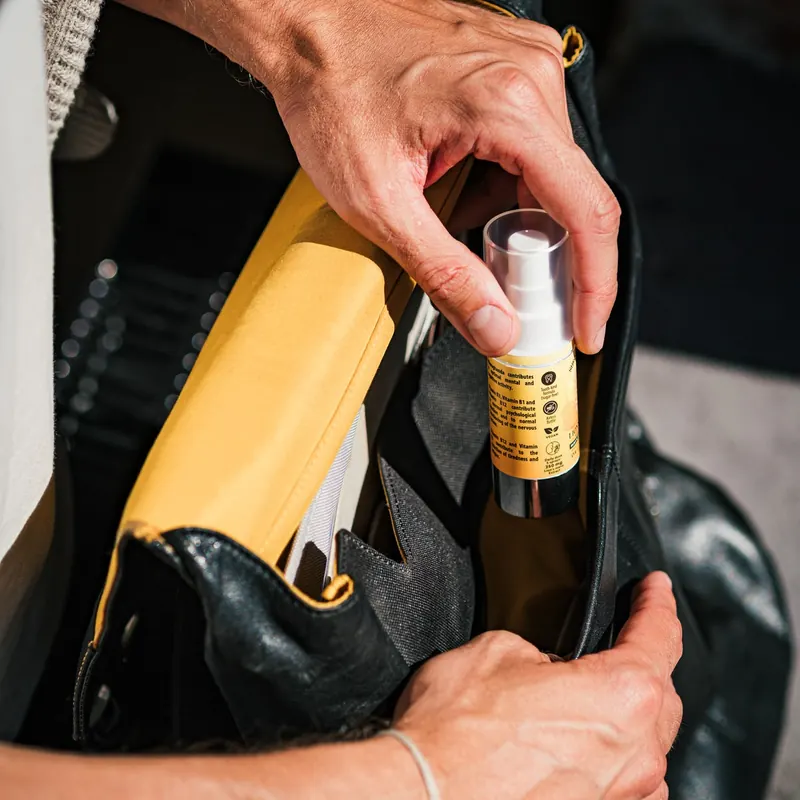
I like that I can carry it in my bag and use it anywhere. The cap sticks sometimes, but I found that if you clean it with water it works perfectly again.
Read those the way I did.
Marta is the honest month, and I've built the page on her.
Marit gave it three stars and says the taste is a long way from the peppermint on the box.
I believe her; a spray with a root extract and a mushroom in it doesn't taste like a candy.
Liisi says the cap sticks and tells you how to clear it.
That's the kind of review I trust most, because nobody writes it to sell anything.
Nobody in the reviews I kept claims anything big. One describes a good month that faded, and that's the effect I believe in: smaller than the box.
If You're Thinking of Buying It for Someone Else
A lot of bottles like this are bought by a wife for a husband, or by a son for a father.
If that's you, a few plain things first.
Does he live in Europe?
Check before anything else. The seller ships within Europe only, and the parcel can't be redirected to an address outside it.
Will he actually use it?
A spray only works as a habit if the person using it wants the habit. Show him this page and let him decide, rather than leaving a bottle on his plate.
Does he take anything daily?
Then the bottle goes to the pharmacist before it goes to the kitchen shelf. Ashwagandha is on the label, and it takes two minutes to ask.
And please, don't hand it over as a promise about his memory.
Hand it over as a morning ritual with mint in it, which is what it is.
If he's the sort who likes to keep score, give him a pocket notebook with it.
That's the part of the gift that will still be useful in a month, whatever the bottle does.
Who It Suits, and Who It Doesn't

This is worth a look if:
- You live at an address in Europe. The seller doesn't ship anywhere else.
- You want a sugar-free, caffeine-free morning ritual with a real label, and you've now seen the label.
- You can hold two ideas at once: real extracts, at amounts far below the trials.
- You like a company with a street address, a phone number and its own mushroom farm, by its own account.
- You'll run it as a thirty-day test with a notebook, the way Marta did, not as a hope.
Give it a miss if:
- You want a trial dose of lion's mane or ashwagandha. Look for the mushroom itself, or an extract with the trial's milligrams on the label.
- You want something that does a clinician's job. This is a food supplement.
- You take anything daily and haven't asked your pharmacist yet. Ashwagandha is on the label, even at a small amount.
- You're sensitive to mushrooms, or to strong mint.
- You want to use it in the afternoon. Read Marta's second sentence again.
- You want it delivered outside Europe. It isn't.
The Honest Objections: Price, Taste, Time and Postage
Every sensible man has a few questions before he spends money on something like this.
Here are the ones I'd ask, with the answers the seller's own pages give.
Is it worth the money?
The day I read it, one bottle cost a little over twenty euros, before shipping. That's about seventy-five euro cents a morning, if it lasts a month.
Is that worth it?
Only if you want the morning gesture and you'll keep the notebook. If you want the trial's dose, no amount of money buys it in this bottle.
What if I don't like the taste?
Then you're in good company with one of the reviewers. Once it's open, it's yours, so the taste is a risk you take on day one.
Why a spray and not a capsule?
The seller says sprays are absorbed well and directly. It doesn't publish a study comparing its spray with anything, so I'd buy the spray because you like the gesture, not because of that sentence.
How long before I'd know?
If it's going to do what it did for Marta, you'll know in the first week. If you're waiting for the twelve-week trial, the bottle was never built to get you there.
Does the postage change the maths?
It does. Shipping inside Estonia is cheap, the Baltic and Nordic countries cost a little more, and the rest of Europe pays a flat charge that can add more than half the bottle's price again.
Can I just try it and send it back?
Only unopened. The European fourteen-day rule lets you return a sealed bottle at your own postage, and an opened one stays with you.
So the fair deal is this: one bottle, one month, a notebook, and your eyes open about all four of those answers.
Six Things Five Sprays Won't Do
- It won't give you the trial's dose of lion's mane. The trial used 3,200 milligrams a day of the whole dried mushroom for twelve weeks; five sprays give 250 milligrams of an extract.
- It won't give you a trial dose of ashwagandha either. Twenty-five milligrams against 300.
- It won't do anything the B vitamins' sentences don't say, and they say "normal." Ten thousand percent of B12 is a label number, not a result.
- It won't taste like the peppermint on the box, according to the one reviewer who said so. Expect mint over something green and bitter.
- It won't ship to the United States. The seller's table covers Europe, from Estonia to the rest of the continent, and stops there.
- It won't come back for a refund once it's open. The seller's rule is the European fourteen days, unopened, at your own return postage.
If that list annoys you, I'd rather you were annoyed now than when the parcel arrives from Tallinn.
If You Do Buy It: One Bottle, One Month, Morning Only, One Line a Day
If you're going to spend the money, spend it the way Marta did, and write it down.
- Buy one bottle. Not two, whatever the shipping table tempts you to do. One month is the test.
- Put it next to the coffee tin and use it at breakfast. Five sprays, once, and the cap back on.
- Never after lunch. Marta paid for that lesson so you don't have to.
- Write one line a day. Not "clear" or "foggy," but what you were doing at ten, and how it went.
- Keep everything else the same for the month, so you know what the bottle does and not what a new routine does.
- On day thirty, read the first week's lines against the last week's. If the effect faded like hers did, the novelty was the effect.
Look at that list the way I do.
Four of the six things cost nothing, the bottle is the one you'll pay for, and the notebook is the one that will tell you the truth.
From Estonia, to Europe Only, With a Fourteen-Day Return Rule
The bottle is sold by Shroomwell on its own website, and that's the only place this page links to.

The current price is shown there, not here.
Now the two things that matter more than the price.
First, where it ships.
Estonia cheaply; Latvia and Lithuania for a little more; Finland and Sweden for a little more again; the rest of Europe for a flat charge.
And that's the end of the table, with no line for the United States or anywhere outside Europe.
If you're reading this from an address outside Europe, this bottle isn't for you, and I'd rather say so than have you find out at checkout.
Second, the return rule.
It's the European fourteen days: you can change your mind within fourteen days of delivery, without giving a reason.
The bottle has to go back unopened and unused, at your own postage unless it arrived damaged or wrong, and the refund follows within fourteen days.
Open it, and it's yours. So open one, and leave nothing else to open.
One bottle of mint for a month of breakfasts
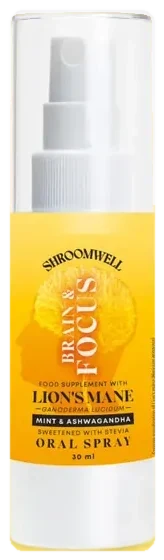
"Boost your focus, sharpen your mind and stay alert with Brain & Focus Spray."
CHECK AVAILABILITY IN EUROPESold and shipped by Shroomwell, Peetri, Estonia, from its own shop in euros · Ships within Europe only, by zone; no delivery to the United States · Refunds only under the European 14-day right of withdrawal, for unopened, unused bottles, at your own return postage
The ingredient and advertising guide linked at the foot of this page goes through every line of the label.
What each thing is, what the research does and doesn't show and at what dose, and what to be careful about.
Print it and take it to the pharmacist if you take anything daily. It's written for that.
Everything Above, in Sixty Seconds
- A white 30-milliliter pump spray from Shroomwell, a mushroom company outside Tallinn, Estonia, with a street address, a phone number and an email.
- Five sprays into the mouth, once a day, in the morning. Sugar-free, caffeine-free, peppermint, vegan.
- Per day: 250 milligrams of lion's mane extract, 50 of L-theanine, 25 of ashwagandha root extract, half a day's B1 and B3, and a hundred days' B12.
- Lion's mane's trial: 3,200 milligrams of whole mushroom a day for twelve weeks in adults over 50. [3] Ashwagandha's: 300 milligrams for ninety days in adults under 55. [5]
- L-theanine has a single-dose study in adults 50 to 69 and a four-week trial at 200 milligrams, which together are the honest explanation for a good first week. [1] [6]
- B vitamins in people who aren't short of them: little or no effect, per Cochrane. [2]
- One real customer's month: clear at first, morning only, quieter by week four. Seventeen reviews, none with a buyer mark.
- Ships within Europe only. Fourteen-day returns, unopened, at your postage, and no refund once a bottle is open.
- The honest use: a sugar-free morning ritual next to the coffee tin. Buy one, keep a notebook for thirty days, and let the notebook decide.

What Readers Ask Me Before Their First Bottle
Questions readers ask
Is this medicine?
No. It's a food supplement made in Estonia, and the sentences on the bottle describe normal function, not an improvement.
Does it ship to the United States?
No. The seller ships within Europe only, by zone, from Estonia.
What does it taste like?
Mint over something green and a little bitter, sweetened with xylitol and stevia. There's no sugar and no caffeine.
How long does a bottle last?
The seller doesn't print the number of sprays per bottle. Marta's review describes about a month at five sprays a day.
Will it help my memory or focus?
I can't tell you that, and you should be wary of any page that does. The trials used far bigger amounts for far longer than five sprays.
Why does the box say one mushroom and the bottle another?
The box and the ingredient list say lion's mane; the bottle prints reishi's Latin name. I go with the box and the list.
Is 10,000 percent of B12 a lot?
It's a hundred days' worth in one dose. In people who aren't short of it, the big Cochrane review found little or no difference to thinking.
Can I use it alongside what I already take?
Ask your pharmacist and take the ingredient guide with you. Ashwagandha is on the label, and the seller's page says nothing about pregnancy.
Should I use it in the afternoon when I fade?
Marta tried that and it kept her up. Use it at breakfast, and keep the afternoon for water and a walk.
What if it arrives and I don't like it?
Unopened, you have fourteen days to send it back at your own postage. Opened, it's yours, which is why the answer to "how many?" is one.
Are the reviews real?
They're public on the seller's site, in Estonian, and I quote three word for word in translation. None carries a buyer mark, so I don't claim anyone bought it there.
What Five Sprays Are Actually Worth
Here's the whole thing in one breath.
A mint, a sweetness and one amino acid that can give you a good first week.
A famous mushroom at a thirteenth of the trial's weight, and a famous root at a twelfth.
A hundred days of a vitamin you almost certainly don't need, and half a day of two you already get.
In a bottle that lives well next to the coffee tin and badly on the afternoon shelf.
If you're a man in Europe who wants a morning ritual with no sugar and no caffeine, and you'll keep a notebook, that's worth one bottle.
Not because of what's in the sprays, but because of what you'll do at nine instead of three.
Buy one, not two, put it next to the coffee, and write one line a day for thirty days. Marta's method is a better judge than I am.
Sold by Shroomwell, Estonia · Ships within Europe only · 14-day returns on unopened bottles
P.S. If you take one thing from this page, take the two numbers.
Three thousand two hundred milligrams a day of whole mushroom for twelve weeks in the trial; 250 milligrams of extract a day in the bottle.
P.P.S. If the slow mornings have been with you for a year, and they're getting in the way of your days, talk to your clinician before you buy anything.
A morning spray is a small habit, and it was never going to answer a question a clinician answers in fifteen minutes.
P.P.P.S. And if you do order it, put it next to the coffee tin, not in the drawer by your reading chair.
Marta wrote the only instruction on this page that came from a month of use, and it's that one.